Gay male identity and the politics of public healt messages
Harrington Park Press - 1984
EL EJEMPLAR PRESENTA SUBRAYADOS EN LAPIZ
AIDS, Communication, and Empowerment examines the cultural construction of gay men in light of discourse used in the media’s messages about HIV/AIDS--messages often represented as educational, scientific, and informational but which are, in fact, politically charged. The book offers a compelling and substantive look at the social consequences of communication about HIV/AIDS and the reasons for the successes and failures of contemporary health communication. This analysis is important because it provides a reading of health communication from a marginal perspective, one that has often been kept silent in mainstream academic research.
AIDS, Communication, and Empowerment offers a critical, historical analysis of public health communication about HIV/AIDS; the ways this communication makes sense historically and culturally; and the implications such messages have for the marginal group which has been most stigmatized as a consequence of these messages. It covers such topics as:
the relationship among gay identity, language, and power
cultural studies of the historical development of gay identity
studies in health communication about HIV/AIDS and health risk communication
the political consequences of public health education about HIV/AIDS on gay men
the political consequences of media representations of gay identity and its relationship to disease
Based primarily on the French scholar Michel Foucault’s critical, historical analysis of discourse and sexuality, this book takes a timely and original approach which differs from traditional, quantitative communication studies. It examines the relationship between language and culture using a qualitative, cultural studies approach which places medicalization theories in the broader context of histories of sexuality, the discursive development of contemporary gay identity, and recent public health communication.
Author Roger Myrick explains how mainstream communication about HIV/AIDS relentlessly stigmatizes and further marginalizes gay identity. He describes how national health education stigmatizes groups by associating them with images of disease and “otherness.” Even communication which originates from marginal groups, particularly those relying on federal funds, often participates in linking gay identities with disease. According to Myrick, government funding, while often necessary for the continuation of community-based health campaigns, poses obvious and direct restrictions on effective marginal education.
AIDS, Communication, and Empowerment allows for a rethinking of ways marginal groups can take control of their own education on public health issues. As HIV/AIDS cases continue to rise dramatically among marginalized and disenfranchised groups, analysis of health communication directed toward them becomes crucial to their survival. This book provides valuable insights and information for scholars, professionals, readers interested in the relationship among language, power and marginal identity, and for classes in gay and lesbian studies, health communication, or political communication.
Growth And Intimacy For Gay Men by Christopher J. Alexander Phd
Growth and Intimacy for Gay Men: A Workbook is an educational workbook for gay men that covers a variety of topics, including family of origin, addiction, self-image, dating and relationships, AIDS and multiple loss, and spirituality. Each chapter provides an overview of the mental health concerns of gay men, as well as exercises the reader can do to facilitate his personal understanding of the issues covered. While the book is written in nontechnical language, making it useful to the general public, its wide selection of workbook exercises makes it useful for psychotherapists and counselors working with gay men.
Growth and Intimacy for Gay Men is written to the reader--with brief examples from the author’s work as a clinical psychologist helping gay men. A central goal of the book is to normalize the feelings and experiences the reader has, as many gay men feel like they’re the only ones with their feelings or experiences. The book’s problem-solving approach addresses:
family of origin--provides exercises to identify and examine gay men’s role in the family, examine their childhood perceptions of being different, and help them map out family patterns and dynamics
self-image--includes self-image assessment questionnaires and written exercises that challenge the reader to look at how they’re affected by societal perceptions
addiction--explores why gay men are vulnerable to addictive behavior and offers strategies for change and self-assessment exercises
dating and relationships--covers the unique challenges faced by gay men, with exercises for single as well as coupled men
AIDS and mental health--provides exercises to help the reader examine the impact of AIDS on his own life and to assess the impact of multiple loss and prolonged grief
Readers can do the workbook exercises on their own, or therapists can assign chapters and exercises as homework, with clients bringing the completed assignment to therapy for more in-depth exploration and discussion. By providing informative chapters and useful exercises, Growth and Intimacy for Gay Men becomes an avenue through which gay men can understand their identity, experiences, and goals.
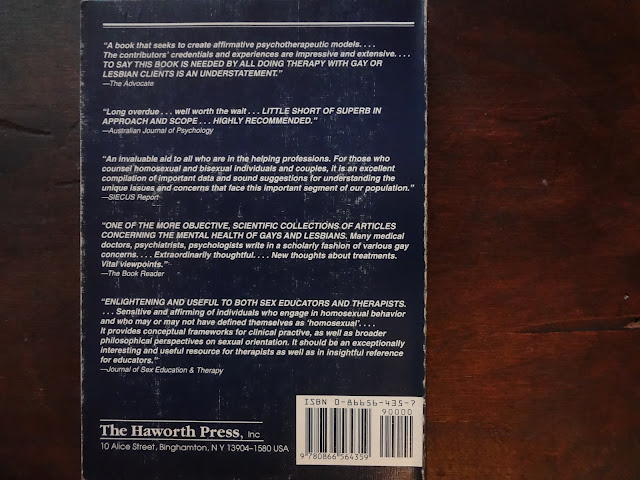
Homosexuality And Psychotherapy Affirmative Models
by John C. Gonsiorek editor
Here is the basic resource for therapists who work with homosexual clients. Written by professionals for professionals, A Guide to Psychotherapy With Gay and Lesbian Clients is an excellent compilation of data and sound suggestions for understanding the unique issues and concerns facing gay men and lesbians.
Gay Midlife And Maturity By John Alan Lee Phd
Aging is stressful for anyone in youth-oriented Western societies. Elderly people encounter difficulties and discrimination, sometimes because of reduced income, transportation and housing problems, and failing health, but often due to the persistent negative stereotypes that color others’attitudes and behavior toward old people. Gay men and lesbians experience these stresses, as well as the numerous additional problems associated with their sexual orientation.
Gay Midlife and Maturity is a dynamic and positive volume that challenges the long-held stereotype of the sad and lonely old homosexual. A growing body of international literature, much of which is featured in this book, rejects this myth and illustrates that older gay men and lesbians cope well with the aging process and are comparable to younger homosexuals in social and psychological adjustment.
A much-needed and major contribution, Gay Midlife and Maturity contains an enormous amount of information for readers interested in gerontology and homosexuality. Experts, for the first time, examine the relationship between the adjustment of gay people to later life and the age and sequence of the resolution of these typically early developmental processes, raising many questions about traditional theories of gay development. The existing contradictions and debates about gay men and accelerated aging are addressed. Other valuable chapters focus on a theory of successful aging, a comparison of the traditional gay community (pre-Stonewall) versus the organized gay community, the vital role of communication in gay relationships, the sexual attitudes and behaviors of older gay men, and much more.
Additional interesting and worthwhile chapters of this thought-provoking new book include an in-depth interview with Don Bachardy about his 33-year relationship Christopher Isherwood, a renowned English writer who was 30 years his senior, and a review of the growing literature on gay aging.


